Stay tune we are working on a great experience for you.

Join our exclusive FREE webinar!
Industry Drug Abuse & Compliance
With Ali Cooper, CUBEX® Senior Director of Corporate Accounts.
Tuesday, 11/18, 2025 at 11:00 am PT | 12:00 pm MST | 1:00 pm CST | 2:00 pm EST


Stay tune we are working on a great experience for you.
Join our exclusive FREE webinar!
Industry Drug Abuse & Compliance
With Ali Cooper, CUBEX® Senior Director of Corporate Accounts.
Tuesday, 11/18, 2025 at 11:00 am PT | 12:00 pm MST | 1:00 pm CST | 2:00 pm EST


Controlled substance logs, occasionally referred to as a “controlled book,” are not only a DEA requirement, they are the “central hub” of DEA compliance and essential to successful recordkeeping. If controlled substance logs are not properly maintained, many other aspects of controlled substance operations will be negatively impacted.
Controlled Substance Logbook Requirements
All DEA registrants must follow DEA recordkeeping requirements outlined in 21 CFR 1304; including veterinary hospitals that practice with controlled substances. DEA controlled substance logging regulations are included in this section; however, these requirements are not a “one-stop-shop”. For example, requirements for records maintenance found in 21 CFR 1304.04, details on how to maintain ongoing, accurate records in 21 CFR 1304.21-26 and inventory requirements in 21 CFR 1304.11. Before diving into the myriad of logging regulations, if you want to be successful with controlled substance logging you need to start the right way.
Successful controlled substance logging starts with proper organization. In addition to playing a key role in DEA recordkeeping, controlled substance logs create the framework that supports the rest of a veterinary hospital’s controlled substance operational infrastructure. You can keep the most meticulously balanced logs; however, if they are not properly organized, you will be at risk for recordkeeping violations.
Setting Up Controlled Substance Logging System
What does that organization look like? When setting up your controlled substance logging organizational system, keep the following in mind:
- Separation: Per 21 CFR 1304.04, schedule II controlled substance logs must be maintained separately from schedule III-V controlled substance logs as well as all other non-federally scheduled medication logs. This includes any logs for “drugs of concern” like gabapentin, proin, and xylazine, even if those substances have been classified as a controlled substance at the state-level. Note - while paper logs require physical separation, electronic logs must be easily segregated.
- Tracking: All controlled substances must be tracked by container from acquisition to disposition. The DEA does not allow “running logs”. For this reason, it is recommended (not required) to label each controlled substance in inventory, whether it is a container, vial, patch, tube, etc., with a unique identifying number or label. Unique identifier labels make it easier to track by container.
- Structure: Controlled substance logs must be organized chronologically by transaction. While DEA regulations do not explicitly state that logbooks must be “bound”, logsheets cannot be loosely kept in folders, stacked in piles, or clipped together. Logs must be maintained in a fixed, chronological order, which is why it is recommended to use bound, numbered, and non-perforated logbooks if you use a paper logging system to ensure that logsheets cannot be easily removed and altered to prevent tampering.
- Retention: The DEA requires controlled substance logs to be maintained on-site at the DEA-registered location in a “ready and retrievable” manner available for inspection for the current two-year period per 21 CFR 1304.04(a). Depending on where you practice, state regulations may require controlled substance logs to be maintained for a longer duration; which is true in states like Illinois and Texas where controlled substance logs must be retained for five years. When state laws are more stringent than federal laws they must be adhered to, so make sure you are aware of your state recordkeeping requirements.
When organized properly, controlled substance logs will support veterinary hospitals by providing enhanced inventory oversight as well as operational clarity.
What Information Must Be Recorded in Controlled Substance Logs?

Veterinary hospitals often ask what information needs to be recorded in a controlled substance log. Just as controlled substance inventory contains medications with different status capacities (backstock, active stock, expired stock), the information recorded within a specific controlled substance logbook depends on the status of the medication being logged.
Container Log Headers
While separate logs are maintained according to a controlled substance container's specific status in inventory, the information included on controlled substance logs headers should remain consistent regardless of whether the container is in backstock, active stock, or expired. All controlled substance container logs should include the following information in the header:
- Name (use the official controlled substance name v. a brand name)
- Strength (2mg/mL, 50 mg etc.)
- Container Size (100 tablets, 10 mL etc.)
- Form (injectable, tablet, patch etc.)
Unopened Container Logs
Logging starts with the receiving process. When a controlled substance order is delivered, as unopened containers are unpacked and verified, they need to be logged as “received” prior to being placed into inventory backstock on what is commonly referred to as an Unopened Container Log.
The information documented within an Unopened Container Log during is different from the information that gets logged on an opened container log because nothing is being dispensed. The documentation being recorded in this log is specific to the controlled substance containers that were ordered coming from the supplier. As such, the following information should be recorded within the Unopened Container Log in “real-time” during receiving:
- Date
- Name of controlled substance
- Unique identifying number or label
- Container size -volume (mL) or # tablets
- Supplier NDC
- Lot number
- Expiration date
- Received by (initials)
- Witnessed by (initials)
- Date moved into active stock
- Moved into active stock by (initials)
- Witnessed move into active stock by (initials)
Nos. 10-12 as noted above within the Unopened Container Log are left blank during the receiving process of logging unopened containers into backstock until those controlled substance containers are ready to be moved into active stock.
Opened Container Logs
When unopened controlled substance containers are ready for use, logging documentation is a two-part process as follows:
PART 1: Completing the Unopened Container Log. When an opened controlled substance is removed from backstock, the blank columns in the Unopened Container Log for those specific controlled substance containers need to be completed to reflect the date they are moved into active stock and by whom.
PART 2: Starting a new Opened Container Log. Since the DEA requires controlled substances to be tracked by container, starting a new log sheet (rather than drawing a line and continuing on an existing logsheet with space remaining on it) is recommended for organizational purposes. Complete the header in full with all required information for the controlled substance container being opened, and then create the first log entry with a starting balance. Once this is done you are ready to begin dispensing from the container for patients.
The information documented on an Opened Container Log for dispensing should include the following:
- Date
- Patient name
- Patient ID (address, medical record ID number, address or other identifying information for easy medical records referencing)
- Unique identifying number or label
- Dispense reason
- Amount/quantity dispensed (mg if tablets, mL if liquid etc.)
- Amount administered
- Amount wasted
- Remaining Balance
- Dispensed by (initials)
- Witnesses by (initials)
- Notes/comments
Expired Container Logs
When controlled substances expire, they must be separated out from non-expired controlled substances in inventory, and that movement must also be logged on a separate Expired Container Log. The same DEA separation rules requiring schedule II logs to be separated out from schedule III-V controlled substance logs applies to expired controlled substances; therefore, make sure that your expired controlled substance logs are maintained accordingly.
As controlled substances that can no longer be used, Expired Container Logs should include the following information:
- Date removed from active inventory
- Name of controlled substance
- Unique identifying number or label
- Container size -volume (mL) or # tablets
- Supplier NDC
- Lot number
- Expiration date
- Received by (initials)
- Witnessed by (initials)
- Date sent for reverse distribution
- Sent by (initials)
- Witnessed by (initials)
Nos. 22-24 as noted above within Expired Container Log are left blank until expired containers are sent to a reverse distributor for final destruction.
Logging Mistakes That Create Compliance Risk
Compliant logging depends on proper training, processes, accuracy and consistency. Every transaction must be documented in “real-time”. The DEA does not allow back-logging or pre-logging.
In addition, the individual logging should be the individual who is actually dispensing or administering. This task should not be delegated to someone else because a staff member is “too busy”. CUBEX chain of custody and fingerprint authentication technology, is one of the ways that veterinary hospitals can ensure they are complying with DEA requirements for “real-time” logging by the individual who dispensed. This feature provides security and access control features while further strengthening accountability by automatically recording who accessed a medication and all associated information surrounding the dispensing transaction.
The majority of controlled substance logging mistakes are avoidable and result from processes being rushed or steps being skipped. Other times logging issues stem from a lack of knowledge and training.
Common controlled substance logging mistakes include:
- Headers: not including all required information for a controlled substance in a log header.
- Waste: Not accounting for waste in patient log entries.
- Hub Loss: Using “pre-determined” hub loss amounts, not documenting hub loss.
- Balance: Failing to properly maintain accurate, running balances following each dispensing transaction for specific controlled substance containers.
- Container Tracking: Not properly tracking each controlled substance by container from start to finish.
- Back-Logging: Not log-logging in “real-time” when controlled substances are actually dispensed.
- Commingling: combining non-federally scheduled drug logs with controlled substance logs.
- Combining: Logging a controlled substance from multiple-sized containers on the same log (ex: 5mL and 10 mL containers).
- Electronic Logs: Not knowing how to properly segregate out schedule II and III-V controlled substance logs from each other as well as all non-federally scheduled drugs upon request within electronic databases.
- Missing Information: Log entries missing required information such as dates, patient information, signatures, witnesses etc.
- Cross-Outs: Log entries containing multiple cross-outs and revisions with no explanations for why they were made or who made them.
- Removing Logbooks From A DEA-Registered Premises: Taking logbooks “home” or otherwise offsite to “catch up” on logging that was never completed.
Reconciliations, Discrepancies and Inspection Readiness
An inventory reconciliation is a process wherein physical counts of controlled substances in inventory (“actual inventory”) are compared against the amounts reflected in controlled substance logs (“expected inventory”). Any difference between the actual inventory and expected inventory is a discrepancy. When discrepancies are identified, they must be investigated, documented and thoroughly resolved. If a controlled substance discrepancy cannot be thoroughly resolved, written notification must be sent to the local DEA division office within one business day of discovery as required under 21 CFR 1301.76(b).
To avoid discrepancies, veterinary hospitals need to reconcile controlled substance inventory regularly. If you are able to reconcile daily that is ideal, but at minimum, try to reconcile weekly. Without a consistent and structured inventory reconciliation process, discrepancies go unaddressed; increasing compliance risk.
Frequent reconciliations = less discrepancies, and reducing discrepancies is what veterinary hospitals need to focus on for “inspection readiness”. Whether it's a state regulatory board or the DEA, when regulatory authorities show up, veterinary hospitals must have all required records “readily available” for inspection upon request ( 21 CFR 1304.04(a)). If discrepancies are identified when controlled substance logs are reviewed, fines for noncompliance are citable up to a maximum of $19,246 per violation. .
Improving Logging Accountability and Accuracy
Paper logging systems work, and can work very well when consistent and disciplined logging practices are upheld. Unfortunately, many veterinary hospitals lack the time and resources that successful manual logging requires, and as a result paper logging systems often fail them.
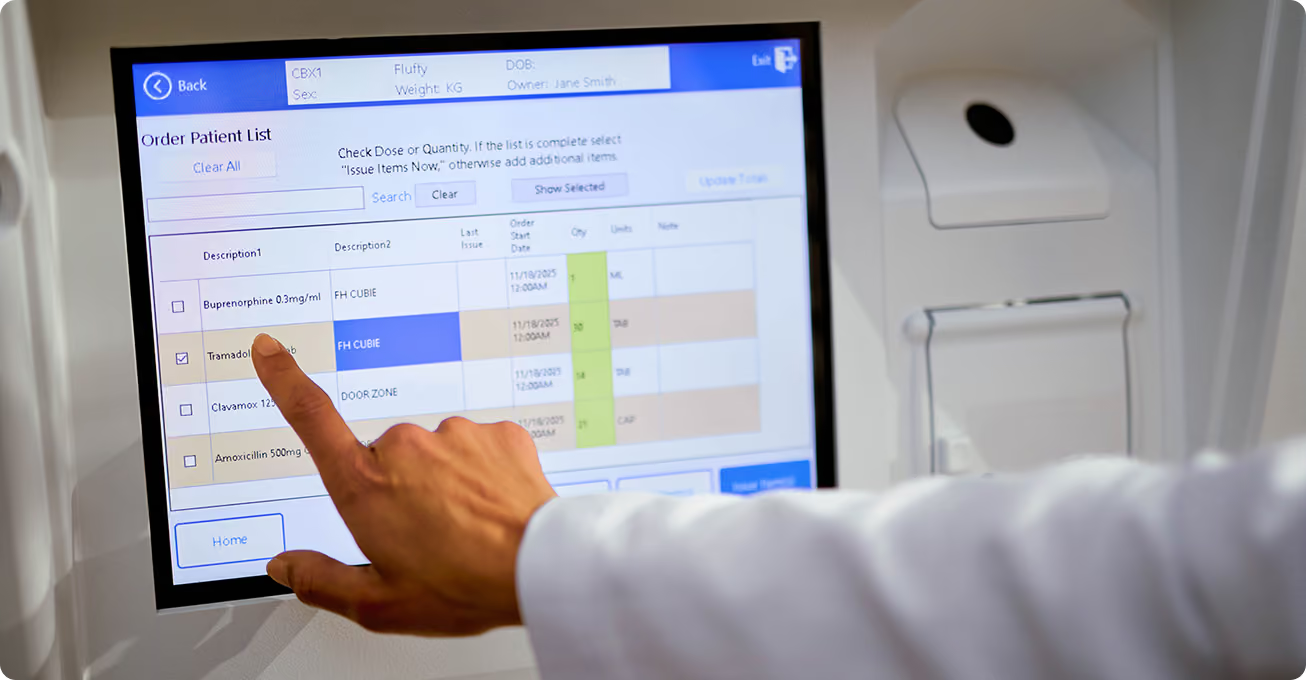
Automated systems can help veterinary hospitals improve controlled substance logging accuracy and accountability while cutting back on time and resources spent completing manual logging processes. Automated systems strengthen the quality of logging documentation by introducing structure along with multiple benefits, including:
- Automating running balance calculations to reduce math errors
- Timestamping every transaction to strengthen audit trail documentation
- Limiting access to authorized users through individual biometric authentication
- Aligning dispensing activity with real-time logging documentation
- Reducing manual reentry of drug names, strengths, dosages, and quantities
- Improving visibility into controlled substance usage patterns
- Simplifying inventory reconciliation procedures
Modern veterinary inventory management software strengthens controlled substance tracking by connecting log documentation directly to dispensing workflows, reducing gaps between what was dispensed, administered, and what was recorded.
CUBEX solutions are designed to support secure controlled substance workflows and structured logging processes. By reducing manual steps and improving traceability, CUBEX helps veterinary hospitals maintain stronger inventory audit trails and clearer oversight of controlled substance medications.
Digital systems do not replace regulatory responsibility. They reinforce it by helping teams stay organized and consistent.
Ongoing Veterinary Controlled Substance Log Book Organization and Compliance
Successful veterinary controlled substance logging starts with organization and is maintained with consistency, accuracy, and discipline. When a veterinary controlled substance log book is properly organized, it supports more than regulatory compliance. It strengthens overall inventory management, improves internal accountability, and reduces the likelihood of unexplained discrepancies.
Clear and consistent documentation protects veterinary hospitals, veterinary teams, and the bottom line. Reliable systems play a significant role in making that consistency achievable. CUBEX is purpose-built for veterinary hospitals, combining secure dispensing hardware with automated logging that timestamps every transaction, limits access to authorized users, and keeps controlled substance records structured and audit-ready without adding steps to an already demanding workflow.
When controlled substance logging is structured and supported by a solution like CUBEX, DEA compliance shifts from being a challenge into being integrated into everyday operations.

Kelley Detweiler is a DEA and controlled substance regulatory compliance specialist who provides solutions to veterinarians through her partnership with Dr. Peter Weinstein in Simple Solutions 4 Vets. She is the DEA compliance CE provider for the American Veterinary Medical Association (AVMA), the co-author of Safeguarding Controlled Substances, published by AAHA Press, and the 2024 recipient of the Illinois State Veterinary Medical Association’s President’s Award.
About CUBEX
CUBEX is an automated inventory management platform for veterinary hospitals. Combining secure smart devices with purpose-built software, CUBEX tracks every dispense in real time, supports controlled substance compliance, reduces waste and stockouts, and streamlines replenishment through connected workflows, including integrations with leading PIMS and supplier ordering platforms. The result is less manual work, better inventory control, and more time back for veterinary teams. Learn more →

Controlled substance logs, occasionally referred to as a “controlled book,” are not only a DEA requirement, they are the “central hub” of DEA compliance and essential to successful recordkeeping. If controlled substance logs are not properly maintained, many other aspects of controlled substance operations will be negatively impacted.
Controlled Substance Logbook Requirements
All DEA registrants must follow DEA recordkeeping requirements outlined in 21 CFR 1304; including veterinary hospitals that practice with controlled substances. DEA controlled substance logging regulations are included in this section; however, these requirements are not a “one-stop-shop”. For example, requirements for records maintenance found in 21 CFR 1304.04, details on how to maintain ongoing, accurate records in 21 CFR 1304.21-26 and inventory requirements in 21 CFR 1304.11. Before diving into the myriad of logging regulations, if you want to be successful with controlled substance logging you need to start the right way.
Successful controlled substance logging starts with proper organization. In addition to playing a key role in DEA recordkeeping, controlled substance logs create the framework that supports the rest of a veterinary hospital’s controlled substance operational infrastructure. You can keep the most meticulously balanced logs; however, if they are not properly organized, you will be at risk for recordkeeping violations.
Setting Up Controlled Substance Logging System
What does that organization look like? When setting up your controlled substance logging organizational system, keep the following in mind:
- Separation: Per 21 CFR 1304.04, schedule II controlled substance logs must be maintained separately from schedule III-V controlled substance logs as well as all other non-federally scheduled medication logs. This includes any logs for “drugs of concern” like gabapentin, proin, and xylazine, even if those substances have been classified as a controlled substance at the state-level. Note - while paper logs require physical separation, electronic logs must be easily segregated.
- Tracking: All controlled substances must be tracked by container from acquisition to disposition. The DEA does not allow “running logs”. For this reason, it is recommended (not required) to label each controlled substance in inventory, whether it is a container, vial, patch, tube, etc., with a unique identifying number or label. Unique identifier labels make it easier to track by container.
- Structure: Controlled substance logs must be organized chronologically by transaction. While DEA regulations do not explicitly state that logbooks must be “bound”, logsheets cannot be loosely kept in folders, stacked in piles, or clipped together. Logs must be maintained in a fixed, chronological order, which is why it is recommended to use bound, numbered, and non-perforated logbooks if you use a paper logging system to ensure that logsheets cannot be easily removed and altered to prevent tampering.
- Retention: The DEA requires controlled substance logs to be maintained on-site at the DEA-registered location in a “ready and retrievable” manner available for inspection for the current two-year period per 21 CFR 1304.04(a). Depending on where you practice, state regulations may require controlled substance logs to be maintained for a longer duration; which is true in states like Illinois and Texas where controlled substance logs must be retained for five years. When state laws are more stringent than federal laws they must be adhered to, so make sure you are aware of your state recordkeeping requirements.
When organized properly, controlled substance logs will support veterinary hospitals by providing enhanced inventory oversight as well as operational clarity.
What Information Must Be Recorded in Controlled Substance Logs?
Veterinary hospitals often ask what information needs to be recorded in a controlled substance log. Just as controlled substance inventory contains medications with different status capacities (backstock, active stock, expired stock), the information recorded within a specific controlled substance logbook depends on the status of the medication being logged.
Container Log Headers
While separate logs are maintained according to a controlled substance container's specific status in inventory, the information included on controlled substance logs headers should remain consistent regardless of whether the container is in backstock, active stock, or expired. All controlled substance container logs should include the following information in the header:
- Name (use the official controlled substance name v. a brand name)
- Strength (2mg/mL, 50 mg etc.)
- Container Size (100 tablets, 10 mL etc.)
- Form (injectable, tablet, patch etc.)
Unopened Container Logs
Logging starts with the receiving process. When a controlled substance order is delivered, as unopened containers are unpacked and verified, they need to be logged as “received” prior to being placed into inventory backstock on what is commonly referred to as an Unopened Container Log.
The information documented within an Unopened Container Log during is different from the information that gets logged on an opened container log because nothing is being dispensed. The documentation being recorded in this log is specific to the controlled substance containers that were ordered coming from the supplier. As such, the following information should be recorded within the Unopened Container Log in “real-time” during receiving:
- Date
- Name of controlled substance
- Unique identifying number or label
- Container size -volume (mL) or # tablets
- Supplier NDC
- Lot number
- Expiration date
- Received by (initials)
- Witnessed by (initials)
- Date moved into active stock
- Moved into active stock by (initials)
- Witnessed move into active stock by (initials)
Nos. 10-12 as noted above within the Unopened Container Log are left blank during the receiving process of logging unopened containers into backstock until those controlled substance containers are ready to be moved into active stock.
Opened Container Logs
When unopened controlled substance containers are ready for use, logging documentation is a two-part process as follows:
PART 1: Completing the Unopened Container Log. When an opened controlled substance is removed from backstock, the blank columns in the Unopened Container Log for those specific controlled substance containers need to be completed to reflect the date they are moved into active stock and by whom.
PART 2: Starting a new Opened Container Log. Since the DEA requires controlled substances to be tracked by container, starting a new log sheet (rather than drawing a line and continuing on an existing logsheet with space remaining on it) is recommended for organizational purposes. Complete the header in full with all required information for the controlled substance container being opened, and then create the first log entry with a starting balance. Once this is done you are ready to begin dispensing from the container for patients.
The information documented on an Opened Container Log for dispensing should include the following:
- Date
- Patient name
- Patient ID (address, medical record ID number, address or other identifying information for easy medical records referencing)
- Unique identifying number or label
- Dispense reason
- Amount/quantity dispensed (mg if tablets, mL if liquid etc.)
- Amount administered
- Amount wasted
- Remaining Balance
- Dispensed by (initials)
- Witnesses by (initials)
- Notes/comments
Expired Container Logs
When controlled substances expire, they must be separated out from non-expired controlled substances in inventory, and that movement must also be logged on a separate Expired Container Log. The same DEA separation rules requiring schedule II logs to be separated out from schedule III-V controlled substance logs applies to expired controlled substances; therefore, make sure that your expired controlled substance logs are maintained accordingly.
As controlled substances that can no longer be used, Expired Container Logs should include the following information:
- Date removed from active inventory
- Name of controlled substance
- Unique identifying number or label
- Container size -volume (mL) or # tablets
- Supplier NDC
- Lot number
- Expiration date
- Received by (initials)
- Witnessed by (initials)
- Date sent for reverse distribution
- Sent by (initials)
- Witnessed by (initials)
Nos. 22-24 as noted above within Expired Container Log are left blank until expired containers are sent to a reverse distributor for final destruction.
Logging Mistakes That Create Compliance Risk
Compliant logging depends on proper training, processes, accuracy and consistency. Every transaction must be documented in “real-time”. The DEA does not allow back-logging or pre-logging.
In addition, the individual logging should be the individual who is actually dispensing or administering. This task should not be delegated to someone else because a staff member is “too busy”. CUBEX chain of custody and fingerprint authentication technology, is one of the ways that veterinary hospitals can ensure they are complying with DEA requirements for “real-time” logging by the individual who dispensed. This feature provides security and access control features while further strengthening accountability by automatically recording who accessed a medication and all associated information surrounding the dispensing transaction.
The majority of controlled substance logging mistakes are avoidable and result from processes being rushed or steps being skipped. Other times logging issues stem from a lack of knowledge and training.
Common controlled substance logging mistakes include:
- Headers: not including all required information for a controlled substance in a log header.
- Waste: Not accounting for waste in patient log entries.
- Hub Loss: Using “pre-determined” hub loss amounts, not documenting hub loss.
- Balance: Failing to properly maintain accurate, running balances following each dispensing transaction for specific controlled substance containers.
- Container Tracking: Not properly tracking each controlled substance by container from start to finish.
- Back-Logging: Not log-logging in “real-time” when controlled substances are actually dispensed.
- Commingling: combining non-federally scheduled drug logs with controlled substance logs.
- Combining: Logging a controlled substance from multiple-sized containers on the same log (ex: 5mL and 10 mL containers).
- Electronic Logs: Not knowing how to properly segregate out schedule II and III-V controlled substance logs from each other as well as all non-federally scheduled drugs upon request within electronic databases.
- Missing Information: Log entries missing required information such as dates, patient information, signatures, witnesses etc.
- Cross-Outs: Log entries containing multiple cross-outs and revisions with no explanations for why they were made or who made them.
- Removing Logbooks From A DEA-Registered Premises: Taking logbooks “home” or otherwise offsite to “catch up” on logging that was never completed.
Reconciliations, Discrepancies and Inspection Readiness
An inventory reconciliation is a process wherein physical counts of controlled substances in inventory (“actual inventory”) are compared against the amounts reflected in controlled substance logs (“expected inventory”). Any difference between the actual inventory and expected inventory is a discrepancy. When discrepancies are identified, they must be investigated, documented and thoroughly resolved. If a controlled substance discrepancy cannot be thoroughly resolved, written notification must be sent to the local DEA division office within one business day of discovery as required under 21 CFR 1301.76(b).
To avoid discrepancies, veterinary hospitals need to reconcile controlled substance inventory regularly. If you are able to reconcile daily that is ideal, but at minimum, try to reconcile weekly. Without a consistent and structured inventory reconciliation process, discrepancies go unaddressed; increasing compliance risk.
Frequent reconciliations = less discrepancies, and reducing discrepancies is what veterinary hospitals need to focus on for “inspection readiness”. Whether it's a state regulatory board or the DEA, when regulatory authorities show up, veterinary hospitals must have all required records “readily available” for inspection upon request ( 21 CFR 1304.04(a)). If discrepancies are identified when controlled substance logs are reviewed, fines for noncompliance are citable up to a maximum of $19,246 per violation. .
Improving Logging Accountability and Accuracy
Paper logging systems work, and can work very well when consistent and disciplined logging practices are upheld. Unfortunately, many veterinary hospitals lack the time and resources that successful manual logging requires, and as a result paper logging systems often fail them.
Automated systems can help veterinary hospitals improve controlled substance logging accuracy and accountability while cutting back on time and resources spent completing manual logging processes. Automated systems strengthen the quality of logging documentation by introducing structure along with multiple benefits, including:
- Automating running balance calculations to reduce math errors
- Timestamping every transaction to strengthen audit trail documentation
- Limiting access to authorized users through individual biometric authentication
- Aligning dispensing activity with real-time logging documentation
- Reducing manual reentry of drug names, strengths, dosages, and quantities
- Improving visibility into controlled substance usage patterns
- Simplifying inventory reconciliation procedures
Modern veterinary inventory management software strengthens controlled substance tracking by connecting log documentation directly to dispensing workflows, reducing gaps between what was dispensed, administered, and what was recorded.
CUBEX solutions are designed to support secure controlled substance workflows and structured logging processes. By reducing manual steps and improving traceability, CUBEX helps veterinary hospitals maintain stronger inventory audit trails and clearer oversight of controlled substance medications.
Digital systems do not replace regulatory responsibility. They reinforce it by helping teams stay organized and consistent.
Ongoing Veterinary Controlled Substance Log Book Organization and Compliance
Successful veterinary controlled substance logging starts with organization and is maintained with consistency, accuracy, and discipline. When a veterinary controlled substance log book is properly organized, it supports more than regulatory compliance. It strengthens overall inventory management, improves internal accountability, and reduces the likelihood of unexplained discrepancies.
Clear and consistent documentation protects veterinary hospitals, veterinary teams, and the bottom line. Reliable systems play a significant role in making that consistency achievable. CUBEX is purpose-built for veterinary hospitals, combining secure dispensing hardware with automated logging that timestamps every transaction, limits access to authorized users, and keeps controlled substance records structured and audit-ready without adding steps to an already demanding workflow.
When controlled substance logging is structured and supported by a solution like CUBEX, DEA compliance shifts from being a challenge into being integrated into everyday operations.
.jpg)