An estimated 80% to 95% of drug diversion cases go undetected, largely due to ineffective monitoring and a lack of proper oversight.1 Ineffective monitoring and lack of proper oversight are both consequences of inadequate supervision.
Inadequate Drug Diversion Monitoring or Supervision
Supervision challenges are an increasing problem throughout veterinary medicine. In many ways, “old school”, stoic veterinary culture still holds strong throughout the industry, where supervision is viewed as unnecessary rather than an opportunity to collaborate. The tendency is to “watch and correct” rather than “mentor and coach”.
In a high-stress, busy veterinary hospital, the environment is often "sink-or-swim"; leaving little to no time for mentorship. As a result, many veterinary professionals in supervisory positions lack proper training and qualifications for the roles they are in; resulting in ineffective leadership, micromanagement and poor employee guidance. It’s no surprise that turnover rates in the veterinary industry are significantly higher than the national average; around 23% for veterinary team members with some studies indicating rates up to 30% for key roles.2
State Supervision Requirements
Supervision is central to veterinary medicine, affecting activities ranging from overall patient care to how controlled substances are accessed and used. Supervision requirements are established by state boards, enacted at the state-level, and set forth within State Veterinary Practice Acts to define and regulate how veterinarians oversee and delegate tasks to support staff. Supervision requirements vary from state-to-state. While all states have them, certain states are stricter than others, particularly when it comes to accessing and dispensing controlled substances.
For example, in Ohio Veterinary Supervision is divided into two main categories:
- Personal Supervision: means to be physically present at the licensed location to deter and detect the diversion of dangerous drugs per O.A.C. Rule 4729:5-19-01(F).
- Direct supervision: means a licensed veterinarian is in the immediate area and within audible range, visual range, or both, of a patient and the person administering to a patient per O.A.C. Section 4741.01(K).
Per O.A.C. Rule 4729:5-19-01(H), the Ohio Board of Pharmacy also requires “Positive ID” for drug dispensing transactions via a secure method of identification. Additionally, under Rule 4729:5-20-03(C), “A registered veterinary technician (RVT) may have access to controlled substances only under the personal supervision of a veterinarian.”
Based on these requirements, if a veterinarian is not personally supervising RVT access to controlled substances, it is a violation of Ohio regulations. This becomes further complicated when Positive ID requirements are not properly adhered to as well.
Ohio regulations as referenced above are one example of many states that have enacted complex supervision requirements in addition to regulations for accessing and dispensing controlled substances that are more stringent than DEA requirements.
The Cost of Poor Veterinary Technician Supervision
When you’re short-staffed and struggling operationally, cutting a few supervision corners may not seem like the worst thing in the world, but do not be fooled. Noncompliance with supervision requirements has a cost.
Violations involving improper supervision of unlicensed personnel, including failure to properly oversee staff and/or procedures generally constitute professional misconduct and are enforceable at the state-level. Penalties can range from state board reprimands, fines, and mandatory continuing education to license suspension or revocation. In cases where serious negligence occurs, violations can lead to civil lawsuits and criminal charges.
Supervision violations involving controlled substances bring federal (DEA) violations into play. At the federal-level, civil monetary penalties (CMPs) for controlled substance violations are citable up to $19,246 per violation. In these cases, both the state and the DEA have authority to assess violations and fines.
If you’re thinking, “state fines are better than DEA fines,” think again. Collaboration and information-sharing between the DEA and state regulatory boards are more aligned today than ever, due to increased diversion and a need for cross-agency support. If a hospital is found to be in violation of state regulations involving controlled substances there’s a strong likelihood the DEA is aware.
Common Supervision Methods
Veterinary supervision is often broken down into three tiers, each reflecting a different degree of veterinary oversight during the performance of animal healthcare tasks. These levels are generally defined as follows:
- Immediate supervision: A licensed veterinarian is directly present, within sight and earshot, while healthcare tasks are being carried out.
- Direct supervision: A licensed veterinarian is on the premises where animal healthcare tasks are being performed and is readily accessible as needed.
- Indirect supervision: A licensed veterinarian is off-site but has provided written or verbal treatment instructions ("direct order") for the animal patient prior to tasks being performed.
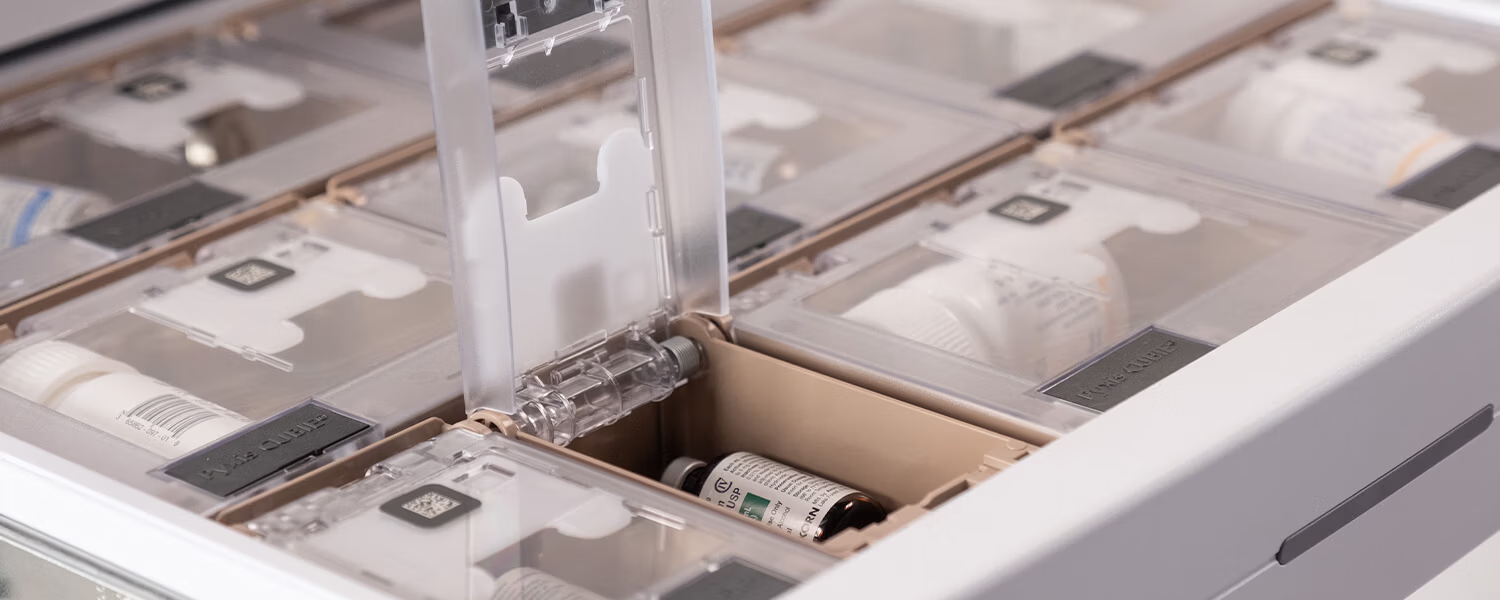
CUBEX inventory solutions all have Fingerprint ID for access to controlled substances and other inventory. This creates a strong process for the proper chain of custody, ensuring safety and compliance.
CUBEX Supervised
Heavy workload demands, poor work-life balance and staff burnout can quickly lead to cutting corners. When this happens, staff supervision is often one of the first aspects of internal operations to suffer.
Veterinary facilities need a consistent, reliable support system that meets state supervision requirements and assists employees in adhering to state and federal controlled substance regulations. CUBEX helps veterinary professionals meet state supervision requirements related to controlled substances in addition to supplemental multiple other areas of daily operations and workflows:
- Identification: CUBEX’s biometric fingerprint access control feature meets real ID requirements for authorized users and witnesses.
- Auditing: Every dispensing transaction is captured in CUBEX; delivering a real-time “who, what, when, and for which patient” documented medication dispensing record; expediting the ability to immediately identify discrepancies.
- Security: 24/7 secure storage of medications in a biometrically access-controlled unit via authorized individual fingerprint authentication, which meets state supervision requirements as well as DEA requirements for DEA registrants to prevent and guard against diversion per 21 CFR 1301.71(a).
- Logging: Automated, electronic logging built into the veterinary inventory management software ensures real-time capturing of dispensing data; reducing human error and identifying discrepancies that are often overlooked in manual systems. This data is accessible to review anytime by authorized staff via the MyCUBEX veterinary software cloud powered by MashuraOS.
- Checks & Balances: CUBEX has built-in, automated checks and balances with its dispensing system designed to enhance overall supervision through increased insights.
- Dispensing: In states that require a supervising veterinarian to be present when controlled substances are dispensed, CUBEX’s Witness Feature is particularly helpful in meeting state supervision requirements and can be customized on the backend in MyCUBEX so that controlled substances are not dispensed without a biometric fingerprint from both the supervising veterinarian and an authorized individual; generating a “real-time” transactional record for dispensing instances.
- Inventory Tracking: Automated inventory management; including alerts for restocking, when medications expire and for reordering.
- Prescription Drug Monitoring Program (PDMP/PMP): If you practice in a state with veterinary PMP requirements, CUBEX PMP automates the recording and submission process; saving time, improving accuracy, and minimizing PMP noncompliance risks.
Integrated Compliance Support
Regardless of the state you practice in, veterinary professionals have a collective responsibility to ensure the protection of inventory, personnel and patients. CUBEX integrated compliance solutions are designed to meet those needs with veterinary practice management software and patient-specific profiles within medical records. Additional add-ons include PMP software and integration with the DEA’s Controlled Substance Ordering System (CSOS) currently in development.3
No one can be everywhere at once. While state regulatory requirements become increasingly complex, veterinary hospitals struggle to retain staff and navigate employee burnout. CUBEX provides a necessary layer of added oversight that veterinary professionals need to ensure adherence to state supervision and controlled substance regulatory requirements.
The cost of noncompliance with state supervision requirements can quickly “snowball” into additional controlled substance noncompliance violations where fines add up quickly. How regulatory agencies ultimately choose to cite and fine violation varies; however, one thing is certain. “I didn’t know” or “I didn’t have enough resources for supervision,” are not an acceptable defense.
State supervision requirements, DEA expectations, and drug diversion risks are not getting simpler. The right systems can help veterinary hospitals strengthen chain of custody, improve accountability, and gain greater visibility into controlled substance activity without adding administrative burden.
See how CUBEX solutions help support supervision, controlled substance security, and inventory management by scheduling a personalized demonstration.
About CUBEX
CUBEX is an automated inventory management platform for veterinary hospitals. Combining secure smart devices with purpose-built software, CUBEX tracks every dispense in real time, supports controlled substance compliance, reduces waste and stockouts, and streamlines replenishment through connected workflows, including integrations with leading PIMS and supplier ordering platforms. The result is less manual work, better inventory control, and more time back for veterinary teams. Learn more →

An estimated 80% to 95% of drug diversion cases go undetected, largely due to ineffective monitoring and a lack of proper oversight.1 Ineffective monitoring and lack of proper oversight are both consequences of inadequate supervision.
Inadequate Drug Diversion Monitoring or Supervision
Supervision challenges are an increasing problem throughout veterinary medicine. In many ways, “old school”, stoic veterinary culture still holds strong throughout the industry, where supervision is viewed as unnecessary rather than an opportunity to collaborate. The tendency is to “watch and correct” rather than “mentor and coach”.
In a high-stress, busy veterinary hospital, the environment is often "sink-or-swim"; leaving little to no time for mentorship. As a result, many veterinary professionals in supervisory positions lack proper training and qualifications for the roles they are in; resulting in ineffective leadership, micromanagement and poor employee guidance. It’s no surprise that turnover rates in the veterinary industry are significantly higher than the national average; around 23% for veterinary team members with some studies indicating rates up to 30% for key roles.2
State Supervision Requirements
Supervision is central to veterinary medicine, affecting activities ranging from overall patient care to how controlled substances are accessed and used. Supervision requirements are established by state boards, enacted at the state-level, and set forth within State Veterinary Practice Acts to define and regulate how veterinarians oversee and delegate tasks to support staff. Supervision requirements vary from state-to-state. While all states have them, certain states are stricter than others, particularly when it comes to accessing and dispensing controlled substances.
For example, in Ohio Veterinary Supervision is divided into two main categories:
- Personal Supervision: means to be physically present at the licensed location to deter and detect the diversion of dangerous drugs per O.A.C. Rule 4729:5-19-01(F).
- Direct supervision: means a licensed veterinarian is in the immediate area and within audible range, visual range, or both, of a patient and the person administering to a patient per O.A.C. Section 4741.01(K).
Per O.A.C. Rule 4729:5-19-01(H), the Ohio Board of Pharmacy also requires “Positive ID” for drug dispensing transactions via a secure method of identification. Additionally, under Rule 4729:5-20-03(C), “A registered veterinary technician (RVT) may have access to controlled substances only under the personal supervision of a veterinarian.”
Based on these requirements, if a veterinarian is not personally supervising RVT access to controlled substances, it is a violation of Ohio regulations. This becomes further complicated when Positive ID requirements are not properly adhered to as well.
Ohio regulations as referenced above are one example of many states that have enacted complex supervision requirements in addition to regulations for accessing and dispensing controlled substances that are more stringent than DEA requirements.
The Cost of Poor Veterinary Technician Supervision
When you’re short-staffed and struggling operationally, cutting a few supervision corners may not seem like the worst thing in the world, but do not be fooled. Noncompliance with supervision requirements has a cost.
Violations involving improper supervision of unlicensed personnel, including failure to properly oversee staff and/or procedures generally constitute professional misconduct and are enforceable at the state-level. Penalties can range from state board reprimands, fines, and mandatory continuing education to license suspension or revocation. In cases where serious negligence occurs, violations can lead to civil lawsuits and criminal charges.
Supervision violations involving controlled substances bring federal (DEA) violations into play. At the federal-level, civil monetary penalties (CMPs) for controlled substance violations are citable up to $19,246 per violation. In these cases, both the state and the DEA have authority to assess violations and fines.
If you’re thinking, “state fines are better than DEA fines,” think again. Collaboration and information-sharing between the DEA and state regulatory boards are more aligned today than ever, due to increased diversion and a need for cross-agency support. If a hospital is found to be in violation of state regulations involving controlled substances there’s a strong likelihood the DEA is aware.
Common Supervision Methods
Veterinary supervision is often broken down into three tiers, each reflecting a different degree of veterinary oversight during the performance of animal healthcare tasks. These levels are generally defined as follows:
- Immediate supervision: A licensed veterinarian is directly present, within sight and earshot, while healthcare tasks are being carried out.
- Direct supervision: A licensed veterinarian is on the premises where animal healthcare tasks are being performed and is readily accessible as needed.
- Indirect supervision: A licensed veterinarian is off-site but has provided written or verbal treatment instructions ("direct order") for the animal patient prior to tasks being performed.
CUBEX inventory solutions all have Fingerprint ID for access to controlled substances and other inventory. This creates a strong process for the proper chain of custody, ensuring safety and compliance.
CUBEX Supervised
Heavy workload demands, poor work-life balance and staff burnout can quickly lead to cutting corners. When this happens, staff supervision is often one of the first aspects of internal operations to suffer.
Veterinary facilities need a consistent, reliable support system that meets state supervision requirements and assists employees in adhering to state and federal controlled substance regulations. CUBEX helps veterinary professionals meet state supervision requirements related to controlled substances in addition to supplemental multiple other areas of daily operations and workflows:
- Identification: CUBEX’s biometric fingerprint access control feature meets real ID requirements for authorized users and witnesses.
- Auditing: Every dispensing transaction is captured in CUBEX; delivering a real-time “who, what, when, and for which patient” documented medication dispensing record; expediting the ability to immediately identify discrepancies.
- Security: 24/7 secure storage of medications in a biometrically access-controlled unit via authorized individual fingerprint authentication, which meets state supervision requirements as well as DEA requirements for DEA registrants to prevent and guard against diversion per 21 CFR 1301.71(a).
- Logging: Automated, electronic logging built into the veterinary inventory management software ensures real-time capturing of dispensing data; reducing human error and identifying discrepancies that are often overlooked in manual systems. This data is accessible to review anytime by authorized staff via the MyCUBEX veterinary software cloud powered by MashuraOS.
- Checks & Balances: CUBEX has built-in, automated checks and balances with its dispensing system designed to enhance overall supervision through increased insights.
- Dispensing: In states that require a supervising veterinarian to be present when controlled substances are dispensed, CUBEX’s Witness Feature is particularly helpful in meeting state supervision requirements and can be customized on the backend in MyCUBEX so that controlled substances are not dispensed without a biometric fingerprint from both the supervising veterinarian and an authorized individual; generating a “real-time” transactional record for dispensing instances.
- Inventory Tracking: Automated inventory management; including alerts for restocking, when medications expire and for reordering.
- Prescription Drug Monitoring Program (PDMP/PMP): If you practice in a state with veterinary PMP requirements, CUBEX PMP automates the recording and submission process; saving time, improving accuracy, and minimizing PMP noncompliance risks.
Integrated Compliance Support
Regardless of the state you practice in, veterinary professionals have a collective responsibility to ensure the protection of inventory, personnel and patients. CUBEX integrated compliance solutions are designed to meet those needs with veterinary practice management software and patient-specific profiles within medical records. Additional add-ons include PMP software and integration with the DEA’s Controlled Substance Ordering System (CSOS) currently in development.3
No one can be everywhere at once. While state regulatory requirements become increasingly complex, veterinary hospitals struggle to retain staff and navigate employee burnout. CUBEX provides a necessary layer of added oversight that veterinary professionals need to ensure adherence to state supervision and controlled substance regulatory requirements.
The cost of noncompliance with state supervision requirements can quickly “snowball” into additional controlled substance noncompliance violations where fines add up quickly. How regulatory agencies ultimately choose to cite and fine violation varies; however, one thing is certain. “I didn’t know” or “I didn’t have enough resources for supervision,” are not an acceptable defense.
State supervision requirements, DEA expectations, and drug diversion risks are not getting simpler. The right systems can help veterinary hospitals strengthen chain of custody, improve accountability, and gain greater visibility into controlled substance activity without adding administrative burden.
See how CUBEX solutions help support supervision, controlled substance security, and inventory management by scheduling a personalized demonstration.