Stay tune we are working on a great experience for you.

Join our exclusive FREE webinar!
Industry Drug Abuse & Compliance
With Ali Cooper, CUBEX® Senior Director of Corporate Accounts.
Tuesday, 11/18, 2025 at 11:00 am PT | 12:00 pm MST | 1:00 pm CST | 2:00 pm EST


Stay tune we are working on a great experience for you.
Join our exclusive FREE webinar!
Industry Drug Abuse & Compliance
With Ali Cooper, CUBEX® Senior Director of Corporate Accounts.
Tuesday, 11/18, 2025 at 11:00 am PT | 12:00 pm MST | 1:00 pm CST | 2:00 pm EST


Walk into any busy veterinary hospital and you’ll find the same challenge playing out in real time: medications need to move fast, documentation has to be airtight, and the margin for error is exactly zero. Whether you’re running a high-volume emergency practice, managing a small general practice where every dollar counts, or overseeing inventory across a multi-site organization, the system you choose to track medications directly shapes your ability to deliver consistent patient care, maintain DEA compliance, and protect your bottom line.
Understanding the differences between hardware-based inventory systems and software-only inventory management systems helps hospital leaders choose an approach that actually fits how their teams work, especially when controlled substances and accountability are involved.
How Veterinary Inventory Systems Support Daily Hospital Operations
Regardless of hospital size or specialty, a well-designed inventory system will consistently support daily hospital operations in several key ways:
- Support accurate medication access during treatment
Reliable inventory data helps staff quickly locate and dispense the right medications during patient care, whether that’s a scheduled procedure or an emergency, without delays or guesswork. - Improve charge capture and financial accuracy
When medication usage is captured at the point of dispensing rather than reconstructed at the end of a shift, charges are far more likely to be recorded correctly. That accuracy compounds over time into real revenue recovery. - Reduce workflow delays and rework
Accurate inventory records prevent the disruptions that slow patient care - stock discrepancies, last-minute substitutions, and the repeated checks when medications or supplies should be easy to find but aren’t. - Provide real time inventory visibility
Real time visibility means your team isn’t relying on yesterday’s counts or someone else’s memory. Stock levels, usage patterns, and reorder needs are visible as they happen, not after the fact. - Align inventory tracking with daily workflows
Veterinary teams move fast and juggle a lot. Inventory systems designed around how teams actually work reduce missed documentation and help create smoother, more consistent operations across the hospital.
What Is a Software-Only Inventory Management System
A software-only inventory management system tracks medications and supplies through digital records, typically updated manually by staff after medications have already been accessed. These systems often integrate with practice management systems and support cloud-based inventory tracking, allowing hospital leaders to review inventory levels and usage reports from a centralized dashboard.
Strengths of Software-Only Inventory Systems
Software-only systems for inventory management can provide broad visibility across a hospital or multiple locations. They tend to deploy quickly and can support multi-location inventory management by consolidating data into a single platform. For hospitals seeking basic inventory insights and reporting, software-only tools can be a practical starting point.
Limitations of Software-Only Inventory Systems
The core limitation of software-only inventory management systems isn’t the software itself; it’s the step between medication access and documentation. In any busy clinical environment, that step is vulnerable. When teams are moving fast, documentation that happens after the fact gets delayed or missed entirely. Because software-only systems don’t physically control access to medications, there is no mechanism to enforce a complete record at the point of use. For general inventory, that gap may carry less regulatory risk, but it’s rarely cost-neutral. Missed charges, untracked usage, and supply discrepancies add up quietly, and most hospitals don’t realize how much until they actually look. For controlled substances, it creates real exposure. Discrepancies that are hard to trace, compliance risk that compounds over time, and the possibility that by the time something surfaces, there’s no clean audit trail to fall back on.
What Is a Hardware-Based Inventory Management System
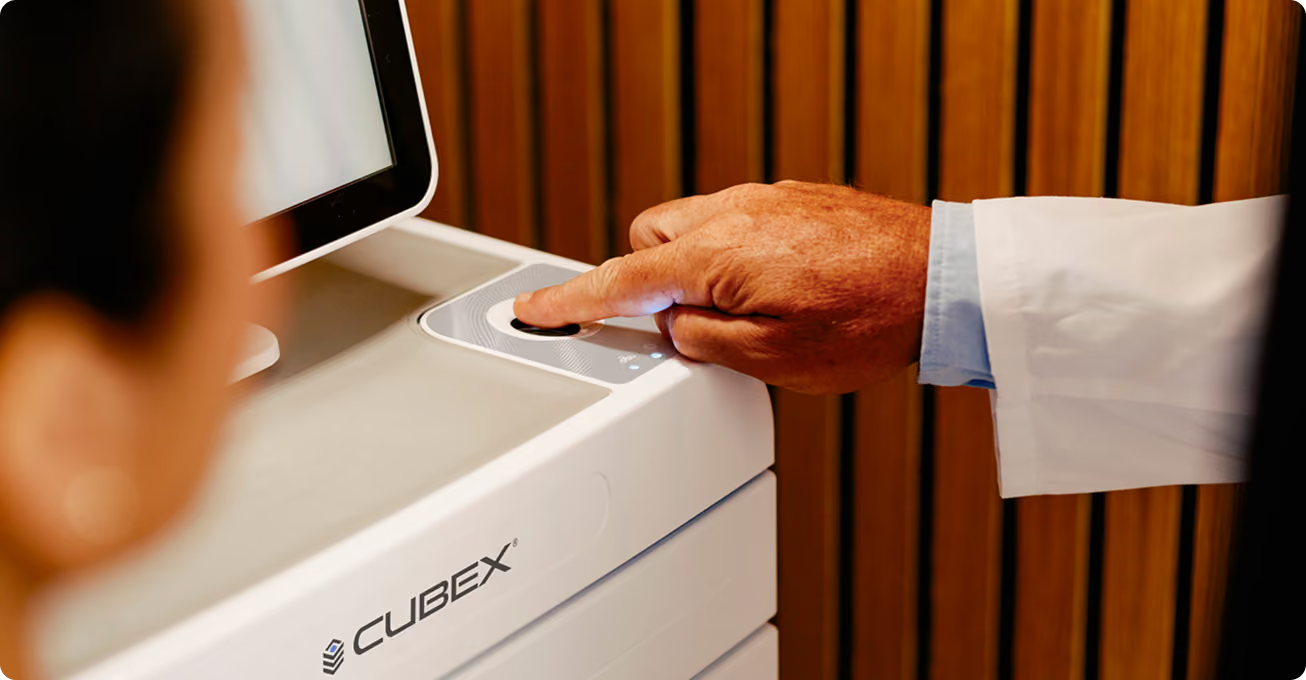
A hardware inventory management system pairs physical medication security with automated software tracking. Medications and supplies are stored in secured dispensing units that require user authentication before access is granted, and every transaction is recorded automatically at the moment it occurs. Rather than depending on a follow-up documentation step, inventory tracking happens as a built-in part of the workflow.
Strengths of Hardware-Based Inventory Systems
Hardware-based inventory management systems build accountability into the access point by design. Only authorized users can retrieve medications, and the system captures a timestamped record of who accessed what and when, without relying on anyone to remember to log it later. For controlled substances specifically, this creates a clear, defensible chain of custody that holds up under scrutiny. It also meaningfully reduces inventory shrinkage. When access is controlled and every transaction is logged automatically, there is far less opportunity for loss to go unnoticed. By aligning access and documentation, it also reduces the day-to-day cognitive load on clinical staff, because the documentation happens automatically rather than as a separate task layered on top of an already demanding workflow.
Limitations of a Hardware Inventory Management System to Consider
Hardware-based systems require upfront investment and physical installation, which is a real consideration for practices evaluating budget and timing. Teams may also need time to get comfortable with new workflows. That said, most hospitals find that the administrative burden of manual reconciliation, discrepancy investigation, and compliance preparation far exceeds the initial transition over time. The bigger question isn’t whether hardware-based systems require more to get started, it’s whether the alternative is actually costing less.
Controlled Substances, Compliance, and Accountability
Controlled substance management in veterinary hospitals is not just an operational challenge, it’s a regulatory one. The DEA holds veterinary hospitals to the same record-keeping standards as human healthcare facilities, and the burden of proof falls on the practice. Studies examining medication diversion in veterinary settings confirms what many practice managers already know from experience: gaps in access control and documentation increase exposure to loss, misuse, and compliance issues, especially when accountability depends on staff-initiated manual reporting alone rather than system-enforced controls.
Hardware-based inventory systems close this gap by connecting medication access directly to automated, timestamped documentation. There is no separate logging step because the record is created the moment the transaction occurs. That structure supports both internal accountability and external audit readiness. CUBEX systems are designed specifically for veterinary hospitals, combining physical security with automated dispensing and inventory management so that controlled substance oversight is built into every transaction, not reconstructed after the fact.
Accuracy, Visibility, and Multi-Location Inventory Management
As veterinary groups and organizations expand, the inventory challenge scales with them. What works reasonably well in a single location gets much harder to manage across five, ten, or twenty sites. Cloud-based inventory tracking can centralize data, but accuracy still depends on how reliably information is captured at each site. Without physical controls in place, input quality varies significantly between sites, shifts, and individuals.
Hardware-based systems support consistency by standardizing how medications are accessed and logged at every location, regardless of who is working or what the shift looks like. That consistency makes multi-location inventory management genuinely comparable and actionable, not just directional. Software-only systems may offer high-level visibility, but without physical controls the underlying data quality may be inconsistent across locations. Discrepancies can persist and multiply as organizations grow. The dashboard then reflects the inconsistency, not the true picture.
Financial and Operational Impact of Inventory System Choice
Inventory management has a direct impact on a hospital’s financial performance. Missed charges, expired medications, unexplained losses, and the staff time spent on manual reconciliation all affect the bottom line. Hospitals that capture medication charges at the moment of dispensing consistently recover revenue that would otherwise slip through. That’s inventory workflow optimization in practice, not a process overhaul, just the right system doing the work at the right moment.
Operationally, trustworthy inventory data reduces time spent resolving discrepancies and improves confidence among staff and leadership. Automated inventory management systems that integrate physical controls can free teams from constant reconciliation, allowing them to focus on patient care and business performance.
Choosing the Right Inventory System for Your Veterinary Hospital
The right inventory system depends on an honest assessment of where your hospital actually is, not where you hope your team’s documentation habits are. Hospitals managing significant controlled substance volumes, operating across multiple locations, or navigating DEA compliance requirements will likely find that software-only solutions create more risk than they eliminate. The gap between what the system is supposed to capture and what actually gets entered is where the exposure lives.
For veterinary hospitals ready to build real accountability into their inventory management, combining physical security with automated inventory tracking is the most resilient approach. CUBEX products are purpose-built for veterinary hospitals, integrating hardware and software to support controlled substance compliance, accurate charge capture, and operational efficiency that scales as your practice does. If you’re evaluating your options, the right question isn’t just which system is easier to implement. It’s which system supports long term profitability and will still be working the way it should when the stakes are high.
About CUBEX
CUBEX is an automated inventory management platform for veterinary hospitals. Combining secure smart devices with purpose-built software, CUBEX tracks every dispense in real time, supports controlled substance compliance, reduces waste and stockouts, and streamlines replenishment through connected workflows, including integrations with leading PIMS and supplier ordering platforms. The result is less manual work, better inventory control, and more time back for veterinary teams. Learn more →

Walk into any busy veterinary hospital and you’ll find the same challenge playing out in real time: medications need to move fast, documentation has to be airtight, and the margin for error is exactly zero. Whether you’re running a high-volume emergency practice, managing a small general practice where every dollar counts, or overseeing inventory across a multi-site organization, the system you choose to track medications directly shapes your ability to deliver consistent patient care, maintain DEA compliance, and protect your bottom line.
Understanding the differences between hardware-based inventory systems and software-only inventory management systems helps hospital leaders choose an approach that actually fits how their teams work, especially when controlled substances and accountability are involved.
How Veterinary Inventory Systems Support Daily Hospital Operations
Regardless of hospital size or specialty, a well-designed inventory system will consistently support daily hospital operations in several key ways:
- Support accurate medication access during treatment
Reliable inventory data helps staff quickly locate and dispense the right medications during patient care, whether that’s a scheduled procedure or an emergency, without delays or guesswork. - Improve charge capture and financial accuracy
When medication usage is captured at the point of dispensing rather than reconstructed at the end of a shift, charges are far more likely to be recorded correctly. That accuracy compounds over time into real revenue recovery. - Reduce workflow delays and rework
Accurate inventory records prevent the disruptions that slow patient care - stock discrepancies, last-minute substitutions, and the repeated checks when medications or supplies should be easy to find but aren’t. - Provide real time inventory visibility
Real time visibility means your team isn’t relying on yesterday’s counts or someone else’s memory. Stock levels, usage patterns, and reorder needs are visible as they happen, not after the fact. - Align inventory tracking with daily workflows
Veterinary teams move fast and juggle a lot. Inventory systems designed around how teams actually work reduce missed documentation and help create smoother, more consistent operations across the hospital.
What Is a Software-Only Inventory Management System
A software-only inventory management system tracks medications and supplies through digital records, typically updated manually by staff after medications have already been accessed. These systems often integrate with practice management systems and support cloud-based inventory tracking, allowing hospital leaders to review inventory levels and usage reports from a centralized dashboard.
Strengths of Software-Only Inventory Systems
Software-only systems for inventory management can provide broad visibility across a hospital or multiple locations. They tend to deploy quickly and can support multi-location inventory management by consolidating data into a single platform. For hospitals seeking basic inventory insights and reporting, software-only tools can be a practical starting point.
Limitations of Software-Only Inventory Systems
The core limitation of software-only inventory management systems isn’t the software itself; it’s the step between medication access and documentation. In any busy clinical environment, that step is vulnerable. When teams are moving fast, documentation that happens after the fact gets delayed or missed entirely. Because software-only systems don’t physically control access to medications, there is no mechanism to enforce a complete record at the point of use. For general inventory, that gap may carry less regulatory risk, but it’s rarely cost-neutral. Missed charges, untracked usage, and supply discrepancies add up quietly, and most hospitals don’t realize how much until they actually look. For controlled substances, it creates real exposure. Discrepancies that are hard to trace, compliance risk that compounds over time, and the possibility that by the time something surfaces, there’s no clean audit trail to fall back on.
What Is a Hardware-Based Inventory Management System
A hardware inventory management system pairs physical medication security with automated software tracking. Medications and supplies are stored in secured dispensing units that require user authentication before access is granted, and every transaction is recorded automatically at the moment it occurs. Rather than depending on a follow-up documentation step, inventory tracking happens as a built-in part of the workflow.
Strengths of Hardware-Based Inventory Systems
Hardware-based inventory management systems build accountability into the access point by design. Only authorized users can retrieve medications, and the system captures a timestamped record of who accessed what and when, without relying on anyone to remember to log it later. For controlled substances specifically, this creates a clear, defensible chain of custody that holds up under scrutiny. It also meaningfully reduces inventory shrinkage. When access is controlled and every transaction is logged automatically, there is far less opportunity for loss to go unnoticed. By aligning access and documentation, it also reduces the day-to-day cognitive load on clinical staff, because the documentation happens automatically rather than as a separate task layered on top of an already demanding workflow.
Limitations of a Hardware Inventory Management System to Consider
Hardware-based systems require upfront investment and physical installation, which is a real consideration for practices evaluating budget and timing. Teams may also need time to get comfortable with new workflows. That said, most hospitals find that the administrative burden of manual reconciliation, discrepancy investigation, and compliance preparation far exceeds the initial transition over time. The bigger question isn’t whether hardware-based systems require more to get started, it’s whether the alternative is actually costing less.
Controlled Substances, Compliance, and Accountability
Controlled substance management in veterinary hospitals is not just an operational challenge, it’s a regulatory one. The DEA holds veterinary hospitals to the same record-keeping standards as human healthcare facilities, and the burden of proof falls on the practice. Studies examining medication diversion in veterinary settings confirms what many practice managers already know from experience: gaps in access control and documentation increase exposure to loss, misuse, and compliance issues, especially when accountability depends on staff-initiated manual reporting alone rather than system-enforced controls.
Hardware-based inventory systems close this gap by connecting medication access directly to automated, timestamped documentation. There is no separate logging step because the record is created the moment the transaction occurs. That structure supports both internal accountability and external audit readiness. CUBEX systems are designed specifically for veterinary hospitals, combining physical security with automated dispensing and inventory management so that controlled substance oversight is built into every transaction, not reconstructed after the fact.
Accuracy, Visibility, and Multi-Location Inventory Management
As veterinary groups and organizations expand, the inventory challenge scales with them. What works reasonably well in a single location gets much harder to manage across five, ten, or twenty sites. Cloud-based inventory tracking can centralize data, but accuracy still depends on how reliably information is captured at each site. Without physical controls in place, input quality varies significantly between sites, shifts, and individuals.
Hardware-based systems support consistency by standardizing how medications are accessed and logged at every location, regardless of who is working or what the shift looks like. That consistency makes multi-location inventory management genuinely comparable and actionable, not just directional. Software-only systems may offer high-level visibility, but without physical controls the underlying data quality may be inconsistent across locations. Discrepancies can persist and multiply as organizations grow. The dashboard then reflects the inconsistency, not the true picture.
Financial and Operational Impact of Inventory System Choice
Inventory management has a direct impact on a hospital’s financial performance. Missed charges, expired medications, unexplained losses, and the staff time spent on manual reconciliation all affect the bottom line. Hospitals that capture medication charges at the moment of dispensing consistently recover revenue that would otherwise slip through. That’s inventory workflow optimization in practice, not a process overhaul, just the right system doing the work at the right moment.
Operationally, trustworthy inventory data reduces time spent resolving discrepancies and improves confidence among staff and leadership. Automated inventory management systems that integrate physical controls can free teams from constant reconciliation, allowing them to focus on patient care and business performance.
Choosing the Right Inventory System for Your Veterinary Hospital
The right inventory system depends on an honest assessment of where your hospital actually is, not where you hope your team’s documentation habits are. Hospitals managing significant controlled substance volumes, operating across multiple locations, or navigating DEA compliance requirements will likely find that software-only solutions create more risk than they eliminate. The gap between what the system is supposed to capture and what actually gets entered is where the exposure lives.
For veterinary hospitals ready to build real accountability into their inventory management, combining physical security with automated inventory tracking is the most resilient approach. CUBEX products are purpose-built for veterinary hospitals, integrating hardware and software to support controlled substance compliance, accurate charge capture, and operational efficiency that scales as your practice does. If you’re evaluating your options, the right question isn’t just which system is easier to implement. It’s which system supports long term profitability and will still be working the way it should when the stakes are high.

.jpg)